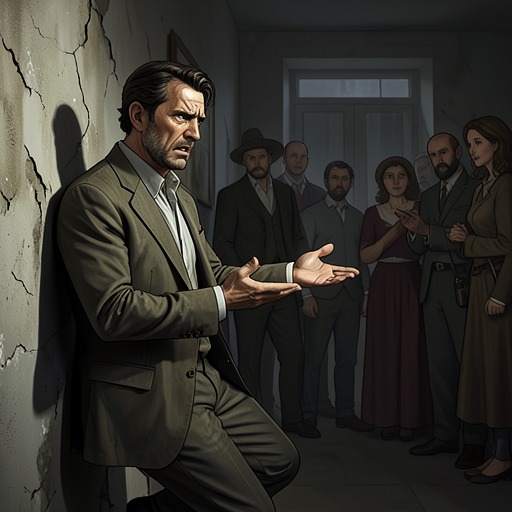
Marvin Schwarz and Rick Dalton’s career meeting
Once Upon a Time in HollywoodMarvin Schwarz and Rick Dalton’s career meeting makes professional advice feel like a verdict: Schwarz offers Rick a possible route back into work, but also forces him to see how the industry now regards him. Rick arrives at Schwarz’s office as a former television star facing a shrinking career; he leaves with a painful diagnosis and a prescription for reinvention. The meeting’s consequences continue beyond the office, shaping how Rick understands his performance and appearance on the set of Lancer, and eventually how he values the career he has had.
The appointment and the story of the missed role
The meeting begins with the buzzer on Schwarz’s desk Dictaphone. His secretary, Janet Himmelsteen, tells him that Rick Dalton is waiting outside, and Schwarz signals that he is ready. The small exchange establishes the encounter as a scheduled piece of business, but the conversation soon shifts from representation to Rick’s place in a changing profession.
Schwarz raises a story he has heard from at least four people: that Rick almost played the role associated with Steve McQueen in The Great Escape. None of his sources, Schwarz says, knows the whole story, so he asks Rick to tell it himself. Rick would rather not revisit the tale. He laughs it off as a story for the Sportsmen’s Lodge crowd and calls the part the one he almost got—the fish that got away. Schwarz, who says those are his favorite stories, presses him to continue. The exchange makes Rick’s old near-miss newly relevant: Schwarz is not merely trading industry gossip but testing the difference between Rick’s remembered potential and his current prospects.
A career assessed without consolation
Schwarz’s assessment is that Italian filmmakers may want Rick, but partly because they cannot get McQueen. Once they accept that McQueen is unavailable, they may turn to a substitute they can hire: Rick. Schwarz illustrates the casting logic by comparing other stars who stand in for preferred choices, and Rick endures the explanation with tears beginning to build behind his eyes. The possibility of work is real, but the terms expose the distance between being wanted for oneself and being hired as the available alternative.
That bluntness brings Rick to a broader confession. After more than ten years in the business, he says, he finds it hard to face what he considers his failure and the way he has run his career into the ground. Schwarz asks what he means by failure. Rick answers by measuring his former promise against particular performances and co-stars: he remembers the strength of his work on Bounty Law with actors including Bronson, Coburn, Meeker, and Vic Morrow, and imagines how different his prospects might have been beside Chuck Heston, Richard Widmark, Robert Mitchum, or Henry Fonda. He points to Tanner, McCluskey, and Hellfire, Texas as films in which something of that promise remained visible, then blames Universal executive Jennings Lang for wasting it. His account is not simply a lament over lost status; it is an attempt to identify where his opportunities went and what kind of actor he might have become.
From humiliation to reinvention
The meeting makes Rick’s professional vulnerability bodily as well as verbal: the stinging tears rise while Schwarz explains his market value. After Rick wipes his face and puts on a false smile, Schwarz tells him not to apologize. Actors, he says, need access to their emotions, even when that capacity comes at a cost. Rick then admits how deeply the conversation has struck him. His distress is not just about a single lost part or an unkind comparison; he is confronting a career history he believes he has mismanaged.
Schwarz does not respond by denying Rick’s account. He calls the past forgivable, then says that moving forward requires reinvention. When Rick asks what he should reinvent himself as, Schwarz answers: somebody humble. The advice is pointed because Rick’s difficulty is not only that Hollywood has changed; his established image and his expectations of his own standing may also obstruct his adjustment to it. Schwarz offers neither a promised comeback nor a restoration of Rick’s former prestige. He identifies a disposition Rick would need if he is to accept the work available to him.
The advice carried onto the Lancer set
The meeting’s diagnosis acquires a visual form when Rick later plays Caleb DeCoteau on Lancer. Walking through the western back-lot streets of Royo del Oro, Rick studies his reflection in a shop window, dressed in Caleb’s costume: a hat, boots, and a brown fringed jacket. The look initially feels unfamiliar, but as Rick watches the fringe move with his gestures, he begins to see the character rather than only himself. The shift connects directly to Schwarz’s earlier description of Rick as an Eisenhower-era actor in a Dennis Hopper Hollywood. Without his familiar pompadour, Rick can imagine that he looks like a different, more contemporary actor—and that the difference may be useful.
Rick also recognizes that the role’s image changes the meaning of his casting. Caleb is the hard-edged antagonist whom Johnny Lancer defeats; Rick thinks that when Johnny kills Caleb, he will not simply be killing Jake Cahill. On the same production, Jim Stacy is initially pleased that Rick, identified with Jake Cahill, will play the heavy opposite his hero. He sees the casting of a well-known television cowboy as a way to make Johnny’s eventual victory carry extra force. The production thus turns Rick’s older screen identity into both an asset and a constraint: it gives the new series a recognizable opponent, even as Rick must accept the villain’s place in its story.
The meeting’s final consequence is not a sudden reversal of Rick’s career but a change in what he can recognize. Near the end of the narrative, a reminder from his young scene partner Trudi Frazer leads him to count what the years have given him: work with admired actors, travel, relationships, stories, a home, and the chance to earn a living by pretending to be a cowboy. He tells Trudi that they are lucky. This later gratitude does not erase the painful appraisal Schwarz forced on him; it reframes it. The meeting first makes Rick see the gap between former promise and present market value, while the later realization lets him see a career as more than that gap.